Expanding Public Utility Service Delivery in Rural and Small-Town Contexts
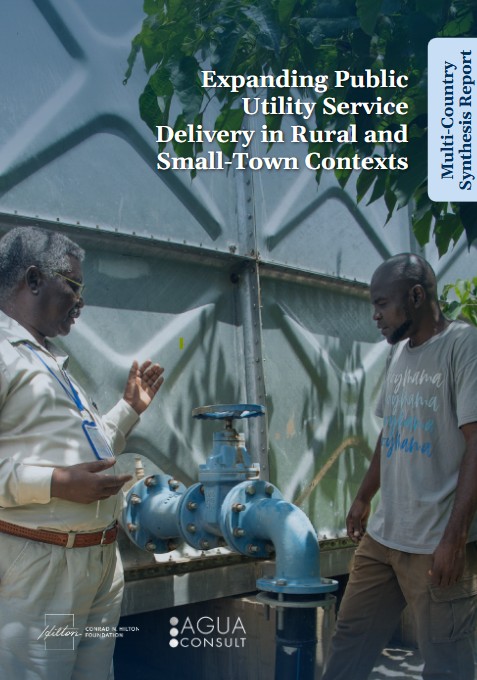 |
Multi-Country Synthesis Report
report Oct 2026 ; 23 pages

Ed. Aguaconsult - Wivenhoe
Downloadable format: PdF
(23 170 ko)
Downloadable from the publisher
 Ghana Report
Kenya Report
Uganda Report
Zambia Report
Abstract:
Ghana Report
Kenya Report
Uganda Report
Zambia Report
Abstract:The expansion of public utility service provision into rural and small-town contexts represents one of the most significant shifts in rural water service delivery in sub-Saharan Africa. In many countries, recent sector policies and regulatory reforms have led to the adoption or expansion of public utility models for rural and small-town water supply services. This trend is occurring through two main pathways:
Pathway 1: Historically urban-focused utilities whose mandates are extended to rural and small-town areas.
Pathway 2: Dedicated rural-focused utilities created from scratch, by modifying the mandate of an existing institution, or by consolidating smaller service providers.
A defining feature of this shift is that these utility models are overwhelmingly established within core government systems, giving them a stronger institutional basis for scaling than the many externally funded, donor-supported operators that have proliferated in recent years.
Aguaconsult, with funding from the Conrad N. Hilton Foundation, recently led a multi-country study to identify the critical factors enabling and constraining effective public utility service provision in rural and small-town contexts.
Keywords: |
access to water (CI) (DT) (ET) (ope) , rural (CI) (DT) (ET) (ope) , small towns (CI) (DT) (ET) (ope) |
Countries: |
Ghana (CI) (DT) (ET) , Kenya (CI) (DT) (ET) , Uganda (CI) (DT) (ET) , Zambia (CI) (DT) (ET) |
Publisher/Broadcaster: |
|
Aguaconsult - Wivenhoe - United Kingdom |
If there is a broken link, we will be pleased to receive a message: communication@pseau.org