''Paying More, Getting Less'' Lebanon's flat tariff water regime, service failure and household coping pathways
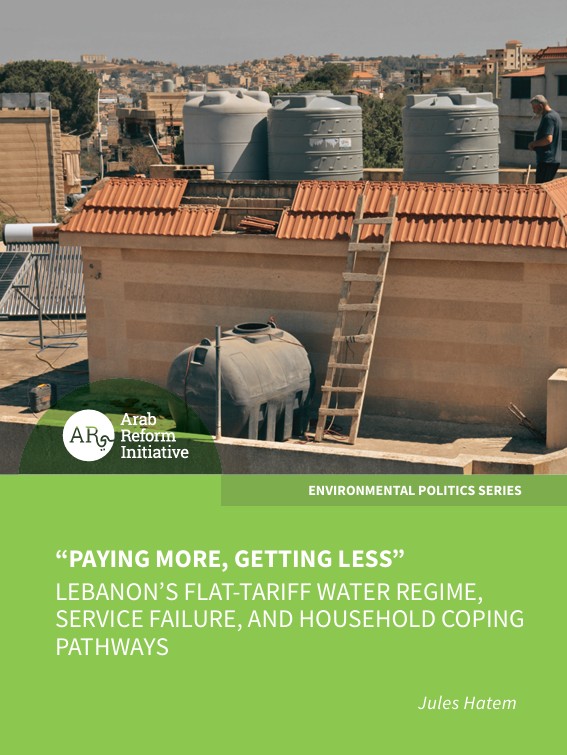 |
publication Jul 2026 ; 32 pages

Aut. Jules Hatem
Ed. ARI - Beirut
Téléchargeable sous format: PdF
(1 910 ko)
Contents:
1. Paying More, Getting Less in Lebanon’s Domestic Water System 7
2. Flat-Tariff Service Bills Access, Not Delivery 8
2.1. The flat-tariff regime as a distributive and procedural injustice 10
2.2. Double payment and the consolidation of hybrid markets 11
3. A Water Justice Lens for Lebanon: Service Outcomes, Burden-Shifting, and Accountability 11
3.1. Governance ingredients that explain variation 12
3.2. Coping pathways as political economy 14
4. Intermittency, Substitute Markets, and the Household Cost Stack 16
5. The Tanker Economy as Substitute Infrastructure 18
6. The Household Cost Stack: Affordability, Regressivity, and Willingness to Pay 19
7. Accountability Without Service 21
7.1. Accountability as lived experience 21
7.2. Transparency, information, and blurred duty-bearing 22
8. Safety Under Hybrid Provisioning: Quality Uncertainty and Unequal Risk Management 23
8.1. How water quality becomes household work 23
8.2. Risk pathways and the regressive cost of safety 23
8.3. What minimum safety governance could look like under constraint 25
9. When the System Works: Three Pragmatic Service Improvements 25
9.1. Hammana 25
9.2. Ouzaii 26
9.3. Al-Qaraoun and al-Buhayra 27
10. What the Successes Teach: Transfer Conditions, Limits, and Practical Synthesis 27
10.1. From nominal access to governed service 28
10.2. Structural limits: What the success stories do not solve 28
11. Changing the Meaning of Payment: Conclusions on Service, Legitimacy, and Water Justice 29
12. Recommendations: A Minimum Governance-and-Operations Package 29
Editeur/Diffuseur: |
|
ARI
-
Arab Reform Initiative - Beirut - Liban |
En cas de lien brisé, nous le mentionner à communication@pseau.org