Associations between rainfall and leaf area index-LAI and nutritional and health indicators in two districts of Southern Madagascar: The HydroNut project
 |
article Jan 2025 ; 11 pages

Ed. Elsevier - Philadelphia
Téléchargeable sous format: PdF
 (4 280 ko)
Abstract:
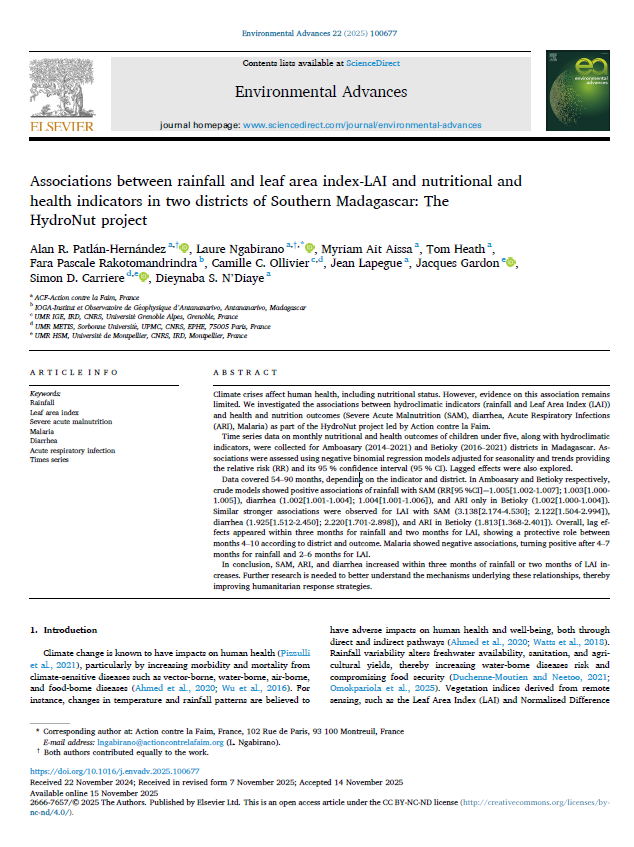
limited. We investigated the associations between hydroclimatic indicators (rainfall and Leaf Area Index (LAI)) and health and nutrition outcomes (Severe Acute Malnutrition (SAM), diarrhea, Acute Respiratory Infections (ARI), Malaria) as part of the HydroNut project led by Action contre la Faim.
Time series data on monthly nutritional and health outcomes of children under five, along with hydroclimatic indicators, were collected for Amboasary (2014–2021) and Betioky (2016–2021) districts in Madagascar. Associations were assessed using negative binomial regression models adjusted for seasonality and trends providing the relative risk (RR) and its 95 % confidence interval (95 % CI). Lagged effects were also explored. Data covered 54–90 months, depending on the indicator and district. In Amboasary and Betioky respectively, crude models showed positive associations of rainfall with SAM (RR[95 %CI]=1.005[1.002-1.007]; 1.003[1.000- 1.005]), diarrhea (1.002[1.001-1.004]; 1.004[1.001-1.006]), and ARI only in Betioky (1.002[1.000-1.004]). Similar stronger associations were observed for LAI with SAM (3.138[2.174-4.530]; 2.122[1.504-2.994]), diarrhea (1.925[1.512-2.450]; 2.220[1.701-2.898]), and ARI in Betioky (1.813[1.368-2.401]). Overall, lag effects appeared within three months for rainfall and two months for LAI, showing a protective role between months 4–10 according to district and outcome. Malaria showed negative associations, turning positive after 4–7 months for rainfall and 2–6 months for LAI.
In conclusion, SAM, ARI, and diarrhea increased within three months of rainfall or two months of LAI increases. Further research is needed to better understand the mechanisms underlying these relationships, thereby improving humanitarian response strategies.
Publics-Cibles:
Université , Ingénieur, concepteur , Socio-économiste , Santé (professionnels de la)
Mots clefs: |
santé (CI) (DT) (OP) (ope) , sécheresse (CI) (DT) (OP) (ope) |
Pays concerné: |
Editeur/Diffuseur: |
|
Elsevier - Philadelphia - Etats Unis |
En cas de lien brisé, nous le mentionner à communication@pseau.org