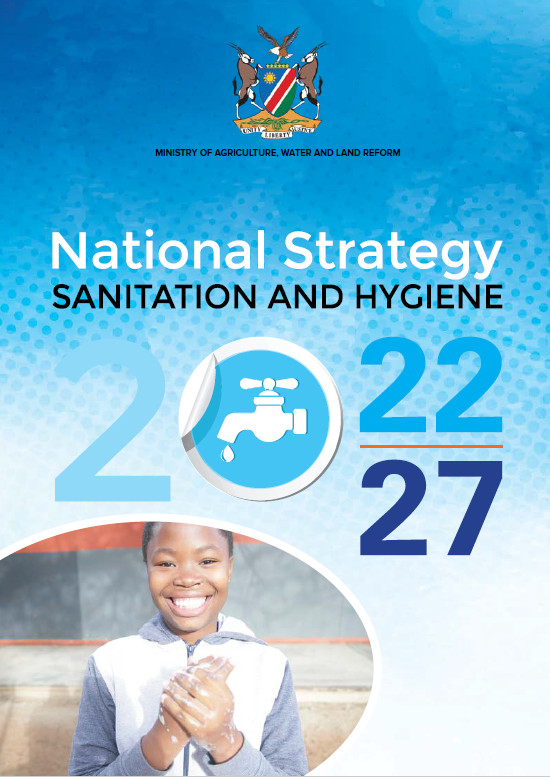
National Sanitation Strategy 2022-2027
 |
rapport Oct 2024 ; 80 pages

Ed. MAWLR - Windhoek
Téléchargeable sous format: PdF
(2 320 ko)
Abstract:
This strategy recommends an integrated approach to the provision of sanitation and hygiene education as a vital ingredient to improve socio-economic welfare and health in Namibia. This can only be achieved by strengthening partnerships and coordination at all levels. The newly established Water and Sanitation Working Group will continue to coordinate Water and Sanitation (WATSAN) activities previously carried out by WATSAN forums. The intention is to strengthen leadership, and effective and efficient stakeholder coordination at national, regional and local levels.
The ultimate goal is to provide 67% of the Namibian population with sustainable access to basic sanitation, and to increase the practicing of safe hygiene behaviours (currently 42%) by 2027. As a result, the strategy articulates various interventions to achieve this goal. These interventions are in the form of focus strategies including: mass awareness campaigns for sanitation and hygiene behaviour change to stimulate the demand for sanitation facilities; improvements in handwashing (boosted by the effect of COVID-19), and elimination of open defecation (ODF); mobilise and encourage communities that are able to afford the costs, to construct their own sanitation facilities, and subsidise fully or partly the sanitation facilities of severely poor households. Contents:
EXECUTIVE SUMMARY.1
1. BACKGROUND AND INTRODUCTION.3
2. STRATEGIC APPROACHES.17
3. OBJECTIVES AND FOCUS STRATEGIES.26
4. KEY STAKEHOLDERS.31
5. BUDGETING.40
6. CRITICAL FACTORS FOR SUCCESS.43
7. ANNEXES.45
END NOTES.64
Mot clef: |
Pays concerné: |
Editeur/Diffuseur: |
|
MAWLR
-
Ministry of Agriculture, Water and Land Reform - Windhoek - Namibie |
En cas de lien brisé, nous le mentionner à communication@pseau.org