Gender disparities in water-related knowledge, perceptions, and governance in rural Ghana
 |
position paper Jul 2025 ; 12 pages

Ed. Aquaya - San Anselmo
Downloadable format: PdF
(5 000 ko)
Downloadable from the publisher
Editor Presentation
Abstract:
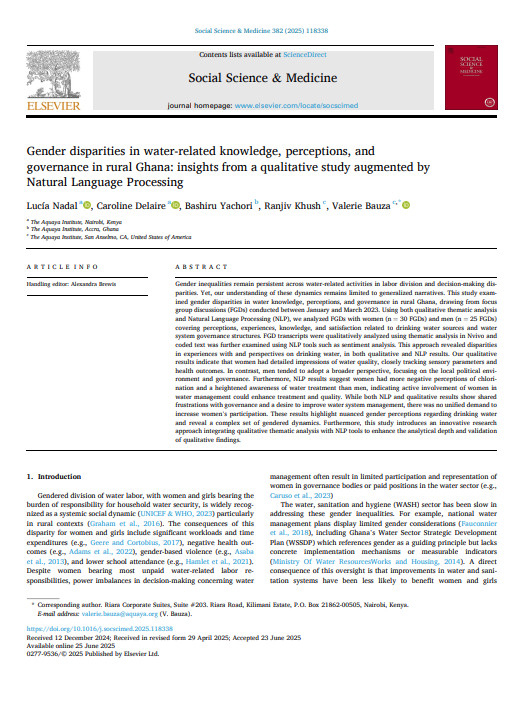
Gender inequalities remain persistent across water-related activities in labor division and decision-making disparities. Yet, our understanding of these dynamics remains limited to generalized narratives. This study examined gender disparities in water knowledge, perceptions, and governance in rural Ghana, drawing from focus group discussions (FGDs) conducted between January and March 2023.
This approach revealed disparities in experiences with and perspectives on drinking water, in both qualitative and NLP results. Our qualitative results indicate that women had detailed impressions of water quality, closely tracking sensory parameters and health outcomes. In contrast, men tended to adopt a broader perspective, focusing on the local political environment and governance.
Furthermore, NLP results suggest women had more negative perceptions of chlorination and a heightened awareness of water treatment than men, indicating active involvement of women in water management could enhance treatment and quality. While both NLP and qualitative results show shared frustrations with governance and a desire to improve water system management, there was no unified demand to increase women’s participation. These results highlight nuanced gender perceptions regarding drinking water and reveal a complex set of gendered dynamics. Furthermore, this study introduces an innovative research approach integrating qualitative thematic analysis with NLP tools to enhance the analytical depth and validation of qualitative findings.
Keyword: |
Country: |
Publisher/Broadcaster: |
|
Aquaya
-
The Aquaya Institute - San Anselmo - Usa |
If there is a broken link, we will be pleased to receive a message: communication@pseau.org